






Your Business Made a Profit – So Where Did the Money Go?(!)
A healthy profit should mean there is plenty of money in the bank.
Shouldn’t it!?
It is one of the most common frustrations we hear from otherwise successful trade and construction business owners:
“We made a good profit, mate but I can’t see the money. Where is it!?”
The financial statements might show a $300,000 profit, while the bank balance tells a very different story.
Tax is due, suppliers need paying, materials need buying, and debts needs servicing – and there is barely enough cash to comfortably cover the next payroll.
It can feel as though the profit has disappeared. But, most commonly it hasn’t disappeared. It has simply gone somewhere else; you just haven’t traced it through.
Understanding where it went is one of the most important steps in moving from running a busy business to running a financially strong one.
Profit and Cash Are Not the Same Thing
Profit measures whether the business earned more than it spent over a particular period, whereas cash flow measures the actual movement of money into and out of the bank account.
They are connected, but they are not interchangeable. A business can be profitable and still experience serious cash-flow pressure; equally, a business can temporarily have money in the bank while trading at a loss.
Profit tells you whether the engine is working. Cash is the fuel that keeps it running. You need to understand both and interact with one another.
So, Where Did the Profit Go?
There are several places profit commonly becomes tied up.
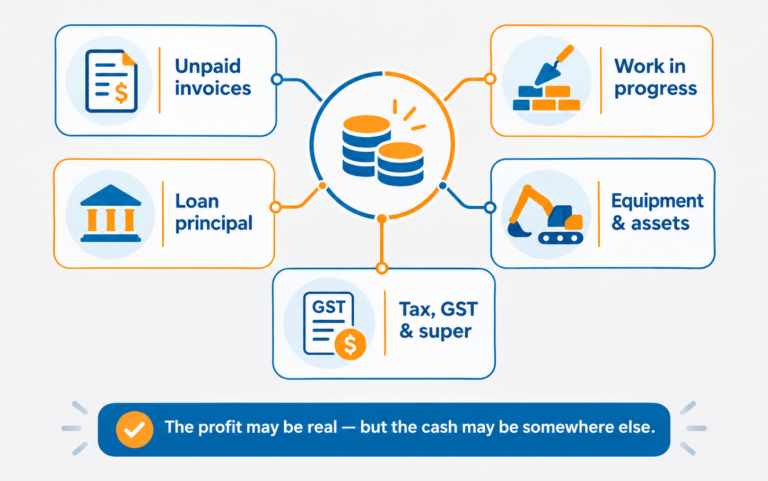
1. Customers Have Not Paid You Yet
Revenue may be recognised when work is completed or invoiced, but that does not necessarily mean the cash has been collected.
If your debtors increase by $100,000 during the year, that is effectively $100,000 of your reported income still sitting in your customers’ bank accounts. You may have earned it. You just don’t have it yet.
This is particularly important in construction, where payment delays, certification processes, disputed variations, and retentions can extend the period between completing the work and receiving the cash.
Sales are not finished when the invoice is issued. Financially, the job is not finished until the money is collected.
2. Cash Is Sitting in Work in Progress
A growing business often has significant cash tied up in incomplete or unbilled jobs. In Accounting speak, this is called Work In Progress, or ‘WIP’.
For instance, you may have already paid for:
- Materials
- Labour
- Subcontractors
- Equipment hire
- Site costs
- Project management, etc.
Until the relevant work (WIP) is invoiced and collected, that money remains locked-up inside the job.
This is one reason rapidly growing businesses can feel increasingly short of cash. Every new project requires more money to be committed before the previous projects have fully paid out.
Growth consumes working capital and if it is not planned, a full order book can become a financial burden rather than a sign of strength.
3. Loan Principal Repayments Do Not Reduce Profit
This one catches many business owners off guard, quite often.
The interest component of a business loan is generally an expense, so you’ll see that effecting profit periodically, but the principal repayment is not. It reduces the loan on the balance sheet rather than reducing the accounting profit.
That means the business might make $300,000 in profit while using $80,000 of its cash to repay loan principal. The debt has reduced, which is a good thing, but so has the bank balance.
The money has not vanished. It has been used to strengthen the balance sheet by retiring from scheduled debt.
4. Property, Plant & Equipment Absorb Cash
A deposit on a new ute, excavator, piece of equipment, or property can require a large amount of cash up front. However, the full purchase price will not necessarily appear as an immediate expense in the profit and loss statement. The asset may instead be recorded on the balance sheet and written off with depreciation over time, subject to the applicable tax and accounting rules.
The result is another gap between the reported profit and the cash in the bank. The purchase may have been commercially sensible. But it still used cash.
A tax deduction does not put the purchase price back into your bank account.
5. Tax, GST and Superannuation Still Need to Be Paid
Some of the cash passing through the business does not belong to the business. You are collecting it and holding it for the ATO, and your employees.
GST collected from customers, PAYG withholding deducted from wages, and employee superannuation obligations must all be paid when due. Income tax may also fall due after the profit has been earned and/or be paid periodically as PAYG Instalments, effectively prepaying the next year’s tax in advance.
The most common problems we see arise when these amounts are treated falsely as available in working capital, rather than being provisioned for, and specifically set aside. The bank balance may look comfortable, but part of it may already be ‘spoken for’.
The ATO is not a silent business partner (even if it occasionally feels like one!).
A Simple Example
Imagine a trade business reports an accounting profit of $300,000 before tax.
During the same period:
- Debtors increased by $90,000
- Work in progress increased by $50,000
- Loan principal repayments totalled $60,000
- Equipment deposits and purchases used $40,000
- The owners withdrew $50,000
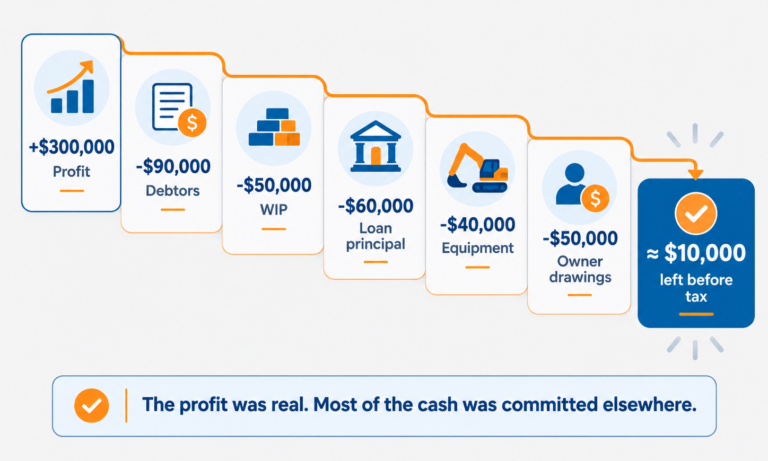
Those items have absorbed $290,000 of cash before considering income tax, GST or other timing differences.
The $300,000 profit was real. But most of the related cash was either not collected, reinvested in the business, used to reduce debt or withdrawn by the owners.
This does not automatically mean anything has gone wrong – quite the contrary. The concern is when nobody understands it until the bank account is nearly empty.
The Christmas Cash-Flow Valley
December and January can expose this disconnect more than any other period.
Many businesses face:
- Christmas shutdowns
- Annual leave payments
- Reduced productive hours
- Supplier accounts falling due
- Customers delaying payments over the holiday period
- January wages before normal collections resume
- BAS, superannuation and tax obligations
- Owners taking additional drawings for holidays and Christmas expenses
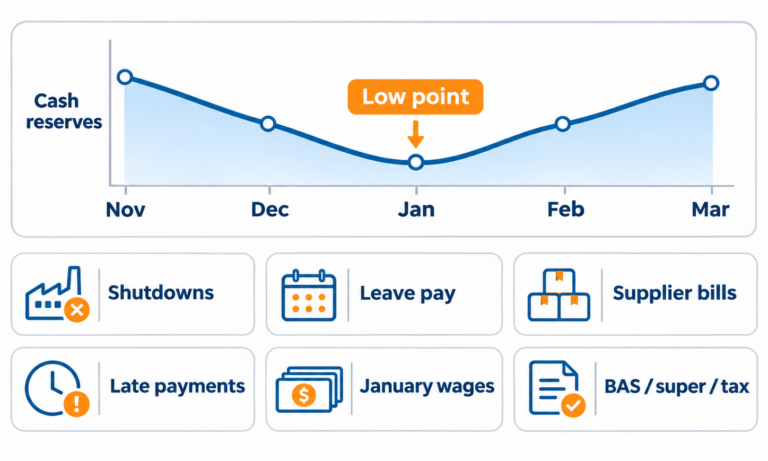
The business may finish December with a respectable profit but enter January with very little financial breathing room.
That should not come as a surprise each year. A rolling cash-flow forecast should identify the low point before the business reaches it. For many trade businesses, an 8-to-13-week forecast is enough to reveal the coming pressure and create time to respond.
Five Questions to Ask About Your Profit & Cash
1. How much of our reported profit has actually been collected?
Review debtors, overdue accounts and retentions. Profit that has not converted to cash cannot pay today’s bills.
2. How much cash is tied up in unfinished or unbilled work?
Understand the value of WIP and how quickly it can be completed, invoiced and collected.
3. How much cash is being used to repay debt or purchase assets?
These payments may not be obvious in the profit and loss statement, but they have a very real impact on the bank balance. Fail to plan for these, and you plan to fail.
4. Are we setting aside enough for tax, GST and superannuation?
Separate these obligations from genuine operating cash. If the money has another owner, do not pretend it is yours. Set up ‘cash buckets’ to hold each different obligation separately so that when the bills arrive, the cash is set aside, ready to pay each one.
5. Are owner drawings sustainable?
The amount an owner can withdraw is not determined solely by the profit figure. The business must also retain enough cash to meet tax, debt, working capital and future investment requirements. It is best practice to be disciplined about this.
Build a Bridge Between Profit and Cash
Every business owner should be able to reconcile their profit to their cash position in reasonably plain English. It does not need to be a 20-page financial report.
A simple bridge can show:
- Reported profit
- Less increases in debtors and work in progress
- Less asset purchases
- Less loan principal repayments
- Less tax payments
- Less owner drawings
- Plus or minus other major movements
- Equals the approximate change in cash
This turns “Where did the money go?” from a frustrated question into a useful management conversation.
Profit Is Important – But Cash Creates Choice
A profitable business has the potential to build wealth. A cash-strong business has the ability to make decisions.
It can pay people on time, negotiate confidently with suppliers, invest in equipment, weather a slow period and pursue good opportunities without relying on expensive last-minute finance.
The objective is not simply to make a profit. It is to consistently convert that profit into cash and then make deliberate decisions about where that cash should go.
Your PROTRADE coach can help improve the operational drivers of profit and cash flow. Your accountant and advisers can help you understand where the money is moving, what the business needs to retain and how future decisions should be structured.
The numbers should never be something you discover months after the event. They should help you decide what to do next.
Profitable Business, Tight Cash Flow?
If your business is making a profit, but cash still feels tight, it’s time to understand where the money is going.
At 4Front, our Business Advisory and Accounting teams can help you identify where cash is tied up, improve cash flow visibility and plan ahead.
Let’s build a future you can look forward to. Book a 45‑minute strategy session or Call us on (07) 3875 9888 or email your enquiries to [email protected] to get started today.